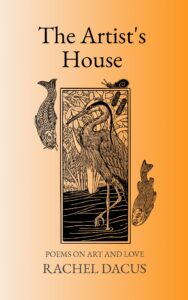
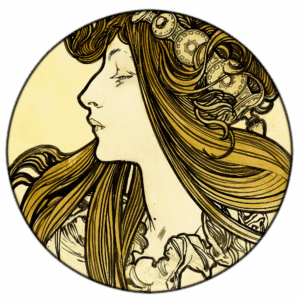
 My new poetry collection. The Artist’s House is a cultural autobiography, honoring the literature, art, and artists that have shaped my writing, with illustrations and interactive features. It will include Art Nouveau style drawings and links to music, dance, and poetry online. Listen to a song by Jacob Collier while reading a poem about Emily Dickinson’s lines dueling with Taylor Swift’s. Watch a performance of Twyla Tharp’s “In The Upper Rooms” ballet after reading the poem it inspired.
This has been a passion project, poems contemplating the world of art and the creative process. I’ve been drawn to contemplate this since childhood, as I grew up with the arts — a father who was a painter and a mother who was a musician. They enriched my childhood with reading, visual art, music, and dance—taking us to see concerts and plays, to visit museum and art exhibitions.
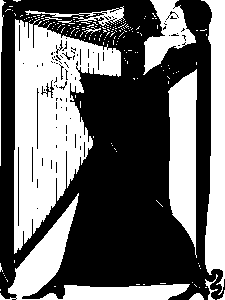
In The Artist’s House I tip my hat to favorite artists—Monet, Caravaggio, Andy Goldsworthy, and Oz book illustrator John R. Neill. Emily Dickinson and Walt Whitman make an appearance, as does Alice Oswald and Aurobindo Ghose. Of course, it had to be an illustrated book! On the wonderful site for royalty-free images, Pixabay, I found artists in the style of one of Art Nouveau and Art Deco, my early visual influences.
I wanted the book to be interactive. Most people read poetry in paperback books, but in my ebook version of the book I include clickable links to performances of music, dance, and talks on art history. Even in the paperback, you can copy and past the links into your browser and have the complementary experiences of art and performances that pair with the poetry.
The idea of including and referencing other works of art in my poems is to offer inspiration. The way I get ideas for my writing is often reading or experiencing another piece of art–a dance, a song, a poem, a novel. Art awakens memories and responses that move me to write. I hope something in the pages of my book does the same for you.
Here’s a poem from the book:
Rules of Truth and Enunciation
You have to apologize to the trees
when you’re discovered laughing
and leaning against their mottled trunks,
calling them temple pillars
when they have simply labored
long and sunward without speech.
The first vow of poetry is silence,
and then to craft sentences
like five-lobed oak leaves.
Metaphors made of autumn’s detritus
of mushrooms and rotting apples.
You may not describe the finches’
songs as a hundred Paganinis
fiddling in the branches,
but you may say a word or sound
about their yellow-throated high notes
as they pinwheel so far as to reach
summer’s glimmering constellations.
You can’t say I am That about lightning
though you may feel afire in love.
You must apologize to the autumn
for calling it summer’s promise unraveling.
Your prayers are best left with little said.
I am, I am, I am may course through you
and make you feel a flare of the divine,
but don’t let it weave syllables
better left to the Mozartian breeze.