


Oswald is an acclaimed British poet, author of the award-winning book Dart, and has published a total of eleven volumes of verse. I happened to dive back into my paperback copy of Woods, etc. and found myself as disturbed, electrified, and fascinated as the first time I read these poems. They form miniature fairytales of nature and natural forces, blended with the chilly realities of mortality, age, and history, as if the Brother Grimm wrote verse or songs.
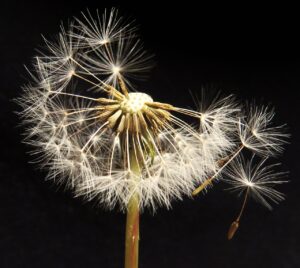
The poem “Head of a Dandelion” pits the fragile seed-head against a pitilessly destructive wind:
This is the dandelion with its thousand faculties
like an old woman taken by the neck
and shaken to pieces.
Later lines clarify the all but futile resistance as a positive act:
In this unequal trial, one thing
controls the invisible violence of the air,
the other gets smashed and will not give in.
The poem finishes transmogrifying the skeleton of the flower as a portrait of resistance in the face of destruction:
this is the flower of no property,
this is the wind-bitten dandelion
worn away to its one recalcitrant element
like when Osiris blows his scales and weighs the soul with a feather.
It seems clear to me that Oswald is speaking of other things than flowers and wind, the forces of nature in and of themselves. She speaks of violence and not giving in to being assaulted. The poem is an affirmation of permanence even as the flower head is being blown apart. It is a poem of protest. To evoke Osiris is to place the personalized dandelion in the realm of myth, of a god or goddess.Though the flower is blown to bits, something remains, and it is a soul.
This is how magical realism works its magic. One thing improbably becomes another, and through the transformation, a curtain is pulled back to reveal a truth. It often works best through stories, and Oswald is an excellent story-teller. Her poems are often narrative, include magical realism in the characters, such as this one about a Benjamin Button backwards in time character.
The mud-spattered recollections of a woman who lived her life backwards
I’ll tell you a tale: one more one morning I lay
in my uncomfortable six-foot small grave,
I lay sulking about a somewhat too short-lit
life both fruitful and dutiful.
We know right away that the narrator is in a magical space — dead but talking about her past life, uncomfortable in death’s confines. We sense what’s coming: a resurrection to lead life all the way back to its origins. The three-page poem has line breaks and these hard-breathed repeated phrases. We feel the woman’s speaking her story aloud, but creating a circularity of time. From a living, speaking nothing back into the nothing — feet first.
What then what then I’ll tell you what then: one evening
there I stood in the matchbox world of chidhood
and saw the stars fall straight through Jimmy’s binoculars,
they looked so weird skewered to a fleeting instant.
Then again and again for maybe the hundredth time
they came to insert me feet first back into nothing
Oswald’s ruminations are every bit as philosophical as they are extended metaphors that spin into stories. She renders her views on life and death, courage and defeat, through personification and myth, using magical realism in poetry to make hers unlike any other poetry I’ve read. She’s a teller of epic stories within miniature utterances, and also a poet of several book-length poems. My favorite of her storytelling book-length works is Dart, the story of a river tole through the voices of those who live and work alongside it. Her poems carry me into many other lives, all bearing an element of otherwordliness.


For me, the best poems embody a moment when I’m suspended in someone’s intimate story. An element of the supernatural, a combination of realism with fantasy, an make those experiences even more vivid and incredibly intimate. It’s like being shown into the livingroom of someone’s heart, the mansion of another’s mind, to live many lives times over, from nothing back to nothing, but having gained much along the way.
You might want to read my essay on magical realism in poetry.
It was chance that made me discover this poet. I read (and somehow have lost) her first collection, The Thing in the Gap-Stone Stile. To paraphrase one critic, she arrived in my poetry world like a zephyr. An original, a mystic, a visionary, of visions not always comforting. I highly recommend her work if you’re a fan of magical realism, of poetry meant to be spoke aloud for its sonic choreography, and of great surprises. You won’t be disappointed.
Alice Oswald was trained as a classicist at New College, University of Oxford. Revered as a major poet in her native England, her honors include prestigious awards like the T.S. Eliot Prize and the Griffin Poetry Prize. More on Alice Oswald at The Poetry Foundation. Her books are available in print and Kindle here.
My poetry collections are available here.